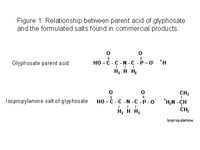
I've seen too many cases where gardeners have inadvertently poisoned the soil in their gardens by not reading the label of the "RoundUp" they bought. They thought that "RoundUp" means "glyphosate".
RoundUp makes about nine different products for the residential market, and none of them contain glyphosate, except the ones with the purple caps that you still might find in garden centers and home improvement stores. That product is no longer being produced. Most of the new RoundUp products contain triclopyr, which should not be used in vegetable gardens or near edible plants (apple trees, blueberry bushes, nut trees). This article (pdf) is a good summary of the ingredients in the various RoundUp products. https://utia.tennessee.edu/publications/wp-content/uploads/sites/269/2024/05/W1237.pdf
Glyphosate (the previous active ingredient in “RoundUp”) is absorbed only by the leaf of the plant, and has a short half-life in soils. Triclopyr, on the other hand, is taken up by both the leaves and the roots, and can persist in the soil for a fairly long time, so it should not be used to clear weeds before planting edible plants. You also have to be very careful when applying it anywhere near the drip line of trees and shrubs, since root absorption is possible.
If you are looking to rapidly kill a growing weed, pelargonic acid, ammonium nonanoate (the ammonium salt of pelargonic acid) or high concentrations of acids (Bonide), solvents (Avenger) or salts (Earth’s Ally) will work on young weeds and annual weeds, without persistent effects in the soil or effects on other plants that are not sprayed, although high amounts of salts can take a long time to leach out. Since these chemicals are caustic, you still need to use appropriate PPE when handling them.
I personally do not use any form of chemical weed control in my gardens, but I do agree that there are occasions where they can be appropriate. In all cases of use, however, please read the labels and look up the effects of the active ingredients. Make sure that the product you are using does what you want it to do without causing any undesired side effects. And be extra cautious if you will be using any product where you, your family or animals might eat the plants.